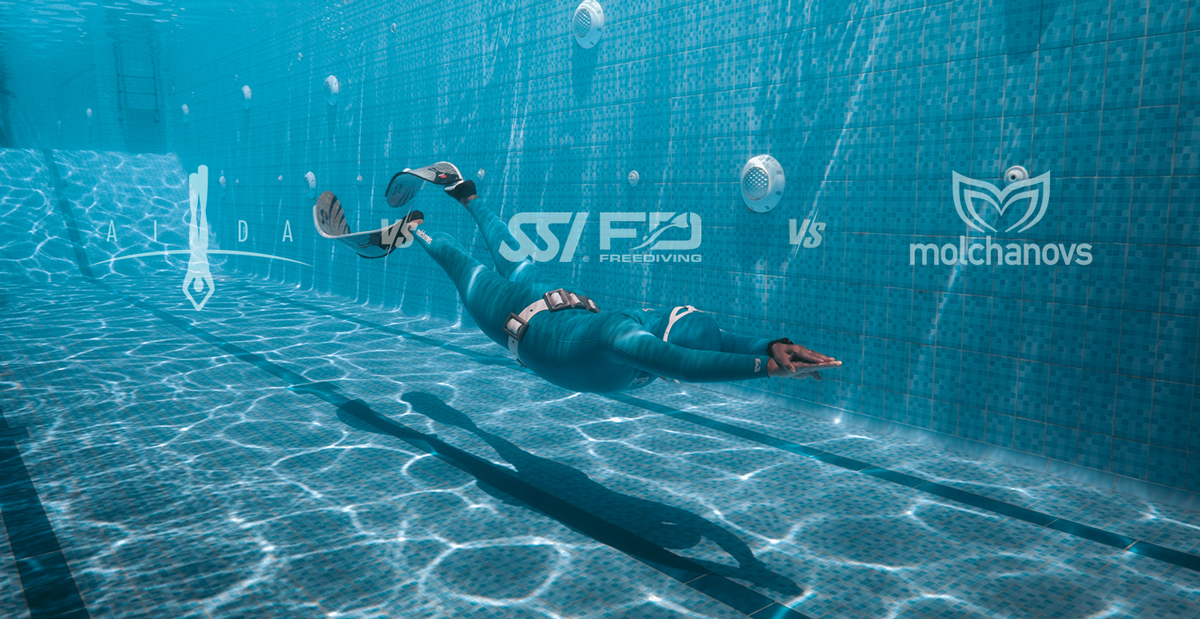
It’s one of the most common questions we get before someone books their first course: which certification system should I go with? AIDA, SSI, Molchanovs — three names that come up constantly in freediving forums, dive group chats and conversations on the beach, generating more confusion than they should.
The short answer is that all three are valid, and for the recreational freediver the practical difference is smaller than it appears. But there are real nuances worth knowing before you decide. At Makara we teach AIDA, and in this post we tell you why — and what SSI and Molchanovs offer, so you have the full picture.
First: there are many more certification agencies
AIDA, SSI and Molchanovs are the three names that come up most in conversation, but the freediving certification world is much wider than that. CMAS (Confédération Mondiale des Activités Subaquatiques), the international federation for underwater activities with decades of history, has its own freediving branch and is the reference system in many countries, particularly in continental Europe. PADI — the giant of scuba diving — also offers freediving certifications through its PADI Freediver programme. Apnea Total is a system with a strong presence in the Spanish-speaking world. And in Italy, Apnea Academy — founded by Umberto Pelizzari, one of the all-time legends of competitive freediving — has a highly respected methodology that is widely used across Europe.
The honest truth is that all of these organisations teach the same fundamentals: freediving physiology, equalization techniques, safety and rescue protocols, and a progressive level structure. The differences lie in emphasis, rigour, recognition in different contexts and which community you end up being part of. None of them teach it wrong.
This post focuses on AIDA, SSI and Molchanovs because those are the three that generate the most questions in international freediving circles. But if you have questions about any other system, ask us.
Where each system comes from
AIDA International
AIDA (Association Internationale pour le Développement de l’Apnée) is the most internationally prominent governing body for competitive freediving. Founded in 1992, it organises world championships and governs a significant portion of official world records. When you see an athlete break an elite freediving record — depth, static time, dynamic distance — they typically do it under AIDA rules. It’s worth noting that CMAS also ratifies its own set of world records: both federations coexist in the competitive space.
Its DNA is sporting and technical. It grew out of the freediving community, not the dive industry, and that shows in how its courses are structured: strong emphasis on physiology, clean technique and clearly defined safety protocols. Levels run from AIDA 1 to AIDA 4, with its own instructor training pathway.
SSI Freediving
SSI (Scuba Schools International) started as a scuba diving organisation and added a freediving branch. It’s widely known in the recreational dive industry — if you’ve seen an SSI logo at a resort dive centre, it’s this system.
Its model is more commercially oriented and accessible. Courses are designed to reach as many people as possible, with more flexibility in how affiliated centres implement them. That has advantages (more availability, more centres worldwide) and disadvantages (less consistency between centres in terms of standards and rigour).
Molchanovs
The newest of the three and the one that has grown fastest in recent years. Created by Alexey Molchanov — current holder of multiple freediving world records and arguably the best competitive freediver alive — built on the methodology developed by his mother, Natalia Molchanova, widely considered the greatest freediver in history.
Molchanovs courses are called Waves: Wave 1 through Wave 4. The philosophy is highly technical and aligned with elite-level practice: strong focus on movement technique, hydrodynamic efficiency and deep understanding of physiology. It has gained significant traction among serious freedivers who value technical rigour and a direct connection to the best in the sport.
The real differences
Recognition within the freediving community
AIDA remains the reference standard in the freediving community. If you want to compete, train as a freediving instructor, or integrate into advanced freediving circles in any country, an AIDA certification is the one that opens doors without explanation.
Molchanovs is growing rapidly and carries increasing weight, particularly among intermediate-to-advanced freedivers looking for a technically solid methodology. Its reputation rises in step with Alexey’s records.
SSI has broad recognition in the general recreational dive sector.
Course structure and rigour
AIDA courses have internationally defined minimum standards: minimum number of dives, minimum depths achieved, mandatory skills evaluated. This gives consistency: an AIDA 2 completed in Dahab represents exactly the same thing as an AIDA 2 completed in the Philippines or the Canary Islands.
Molchanovs sets a high technical bar, especially regarding movement efficiency and body position in the water. Its instructors are trained to give detailed technical feedback. If you want to genuinely improve as a freediver, the Molchanovs methodology is very solid.
SSI gives more operational autonomy to its affiliated centres. In practice, the experience varies depending on the instructor and the centre — as with any global franchise system.
Are they interchangeable?
In practice, centres usually accept equivalent certifications from other systems after a brief evaluation. If you have an AIDA 2 and want to do Molchanovs Wave 3, or SSI Level 2 and want to do the AIDA 3, the instructor will typically assess your real level before starting (called crossover). The paper matters less than what you can actually do in the water.
Why Makara teaches AIDA
Not an arbitrary choice. Irina, our freediving instructor, trained with AIDA and Apnea Total and has spent years inside the freediving community. AIDA is the system under which clearest safety standards are set and the widest recognition in serious freediving circles globally.
For us, teaching with AIDA is consistent with what we are: a small, technically rigorous school that puts safety and teaching quality ahead of student volume.
We also recognise that Molchanovs is a system with a technically excellent methodology. It deserves its growing reputation.
Profile
Highlights
- Continuous progression
- Physiology and technique
- Safety and rescue
- Wide recognition
Levels
Ideal for
Profile
Highlights
- Wide network of centers
- Digital learning
- Recreational training
- Flexibility
Levels
Ideal for
Profile
Highlights
- Technique and efficiency
- Physiology
- Competition and high performance
- Performance-oriented
Levels
Ideal for
So which one should you choose?
Choose AIDA if: you want the most globally recognised certification in the freediving community, you’re interested in competing or training as an instructor, or you simply want the most established standard.
Choose Molchanovs if: you’re looking for a highly technical methodology, the Molchanov philosophy resonates with you, and there’s a quality Molchanovs centre available where you want to train.
Choose SSI if: the best centre available at your destination teaches SSI.
In Dahab, with us: AIDA, taught in English and Spanish.
Questions about which level to start at? Get in touch — we’ll advise you honestly.
FAQ
Is my AIDA certification valid worldwide?
Yes. AIDA certification is international and recognised at freediving centres everywhere.
Can I switch between systems?
Yes, though not automatically. Centres will assess your real level before continuing with their system.
AIDA or Molchanovs if I want to become an instructor?
Both have solid instructor training pathways. AIDA has broader global presence; Molchanovs has a growing technical reputation. If you already know which centres you’d want to work with, look at which system they use.
Do certifications expire?
No. AIDA, SSI and Molchanovs certifications have no expiry date.