

Dahab’s Blue Hole has a nickname that does more for its reputation than its safety record deserves: the divers’ cemetery. It’s dramatic, it travels well online, and it’s mostly wrong.
The hole itself is a sinkhole almost 110 metres deep, right off the shore, opening into the sea through a shallow six-metre ledge known as “the saddle.” On its own, it’s no more dangerous than any other dive site in the Red Sea. What has caused accidents — several of them fatal — is a specific feature inside it: the Arch.
The Arch is the real story
‘The Arch sits in the wall of the hole at 56 metres, a tunnel roughly 25 metres wide that runs for 30 metres before opening into open water. That depth alone puts it outside recreational diving limits (40 metres), which means it’s a technical dive only — deeper gas, higher pressure, and a much smaller margin for error than a normal reef dive.
Most of the divers who’ve gotten into trouble here tried it on a single tank of air, without the training or gas planning a dive like this actually requires. That’s not the hole being dangerous. That’s the depth limits doing exactly what they’re there to do when someone ignores them.

The Arch got a fresh wave of attention after Netflix’s The Deepest Breath, which follows freediving’s obsession with crossing it on a single breath. Natalia Molchanova and William Trubridge both managed it — with a monofin and without fins, respectively — which tells you everything about how much skill and preparation separates “possible” from “reckless.”
What actually goes wrong at depth
Past a certain point, depth plays tricks on the brain. Nitrogen narcosis brings overconfidence, euphoria, confusion, sometimes hallucination — exactly the mental state you don’t want 50-plus metres down with a limited air supply. As pressure builds, the oxygen in a standard air mix can turn toxic too.
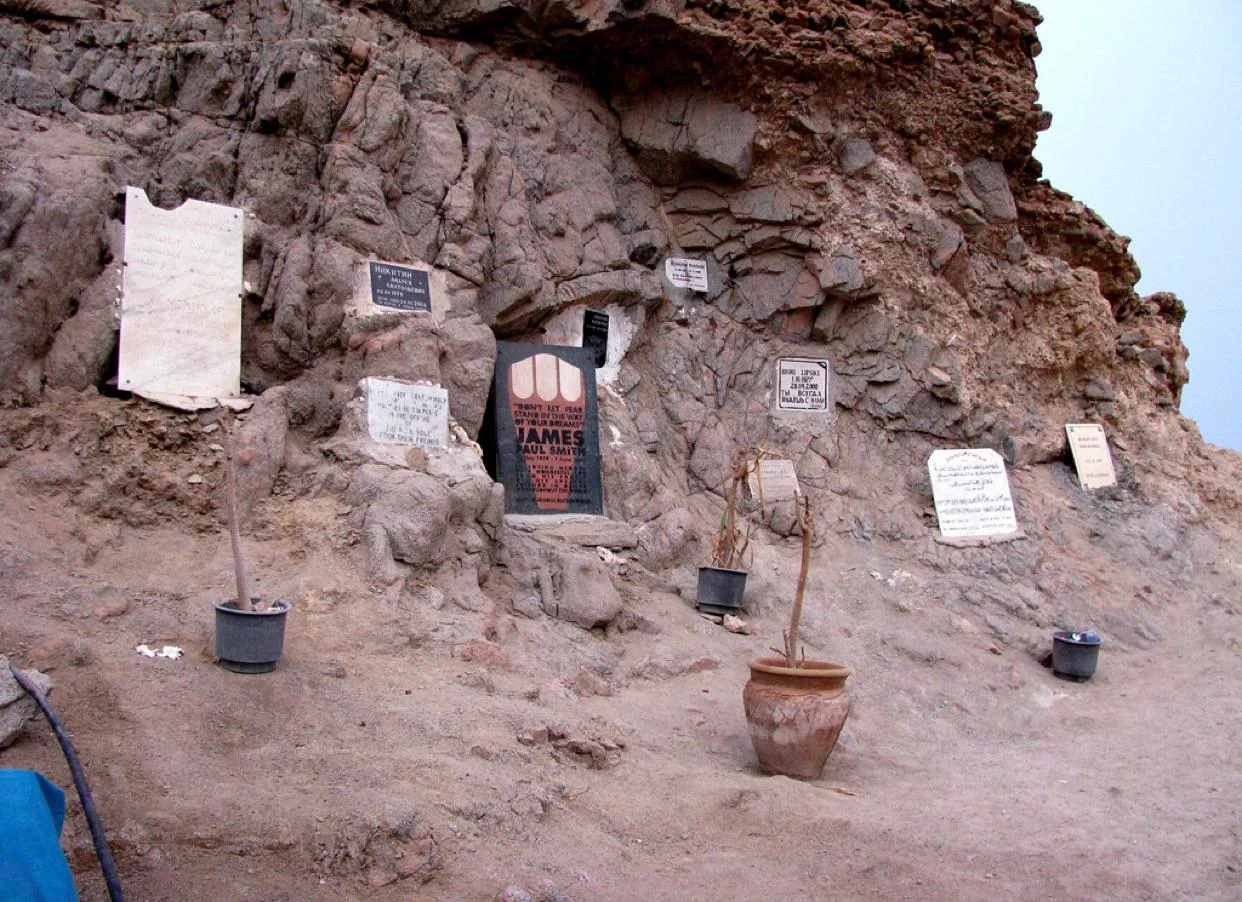
commemorative plaques of some of those who died in the Blue HoleOne of the more sobering stories tied to this place is Yuri Lipski, an Israeli-Russian diving instructor who died past the 100-metre mark. His helmet camera was recovered intact, and the footage suggests he descended alone, by choice, past every limit that would have kept him safe.
The pattern holds across most incidents here: it’s very rarely the site. It’s human error — going deeper than trained for, alone, without respecting what the depth does to judgment.
So — should you dive it?
Yes. The Blue Hole is one of the most extraordinary dive sites on the planet, and for the vast majority of visitors — divers and freedivers diving within their certification and their limits — it is simply a spectacular, safe site. The Arch is there for those who’ve earned the training to attempt it. Everyone else gets one of the best dives of their life without ever needing to go near it.
Depth limits exist for a reason. Respect them, and this is one of the best days you’ll have underwater.
Ready to discover Dahab? Contact us and we will help you to arrange everything you need for your staying in Dahab!