
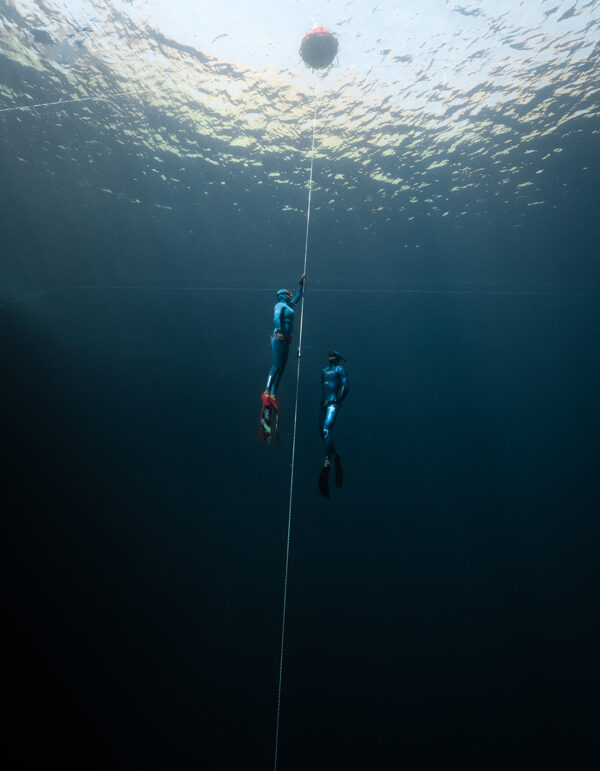
There are places that mean different things to different people. To the tourist, Dahab’s Blue Hole is a perfect postcard: turquoise water, golden coral, Sinai sky. To the scuba diver, it’s a coral wall dropping into the blue. To the freediver, it’s something else entirely. It’s a perfect water column — no current, easy acces to depth, a stillness that few natural structures on earth can offer. For many freedivers, it’s the most beautiful place they’ve ever held their breath.
We’re Makara and we live in Dahab and have spent years guiding freedivers of all levels on their descents through the Blue Hole. This is what it actually looks like from the inside.
What the Blue Hole is — and why freedivers love it
The Blue Hole is a geological formation in Dahab’s coral reef: a circular opening roughly 60 metres across that drops vertically from the reef platform to over 100 metres deep. It connects to open water through a passage at around 55 metres called The Arch.
For technical scuba divers, The Arch is both the attraction and the trap— many of the Blue Hole’s historical accidents happened when divers attempted the crossing without adequate training. For recreational freedivers, The Arch is irrelevant. Freediving the Blue Hole means descending vertically in the centre of the column, where the depth is effectively limitless and the conditions are always perfect.
Three things make the Blue Hole exceptional for freediving: zero current, exceptional visibility(25–30 metres normally), and surface entry from the reef platformless than a metre deep. You walk in, set your descent line, and you have a perfect blue column disappearing below you.
Getting there and setting up a session
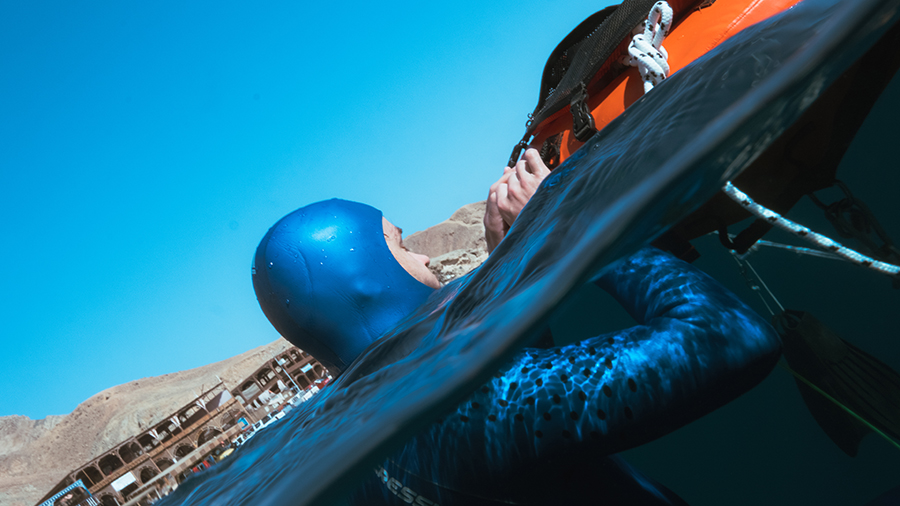
The Blue Hole is about 8 kilometres north of central Dahab — a 10–15 minute drive. Access is by land: a rocky path along the reef edge leads to the entry platform. No boat, no queue, no tourist machine. You arrive, kit up and get in.
The entry platform sits at water level. From there you deploy the descent line and set up the safety system. There is always a safety freediver in the water, typically at half the target depth, ready to assist if needed.
When we take students to the Blue Hole, every session follows the same structure: warm-up in the shallow reef, safety briefing, progressive descents starting conservatively, and never more than the freediver is ready for that day.
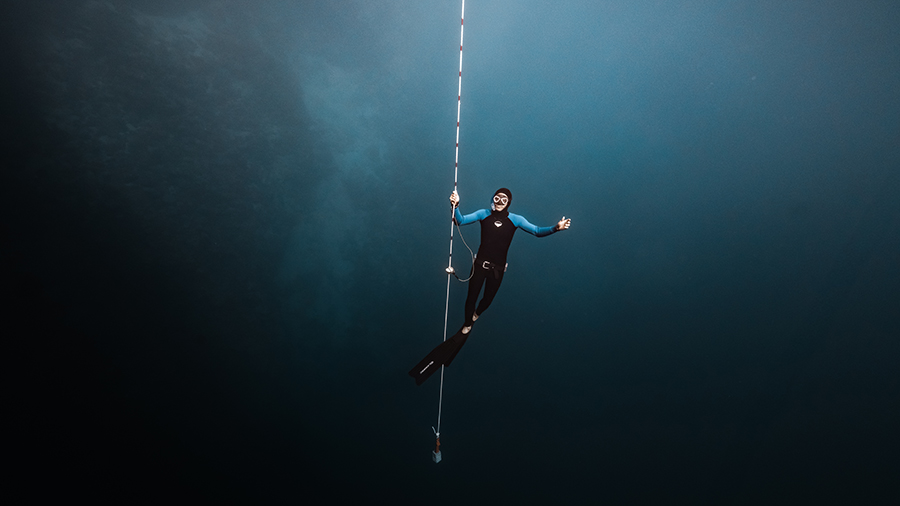
The descent: what you feel at each depth
- From 0 to 10 metres: leaving the surface. The first few metres are the most physically active. The body still floats; you’re pushing against positive buoyancy. Sunlight cuts obliquely from above, the coral rim of the hole passes on each side. Surface sounds disappear almost immediately.
- From 10 to 20 metres: neutral buoyancy. Somewhere around 10–15 metres — depending on weighting and suit — the body reaches neutral buoyancy. It stops floating and stops sinking. Many freedivers describe this as the first moment of true weightlessness. Finning becomes unnecessary; the body glides. For AIDA 2 students, this is home territory. The course certifies to 20 metres, and the Blue Hole is the ideal place to reach them.
- From 20 to 30 metres: AIDA 3 territory. Beyond 20 metres, lung compression becomes perceptible. The wetsuit loses volume, the body becomes denser, the fall accelerates. Equalization — pressure compensation in ears and sinuses — needs to be active and calm, never forced. The blue at this depth takes on a darker, denser quality. Light from above is still visible but feels distant. Some freedivers describe this zone as the most “outer space” part of the descent.
- From 30 to +40 metres: lungs are substantially compressed, equalization requires advanced technique (advanced Frenzel or Mouthfill), and freefall — passive descent without active pushing or finninf — takes over completely. The body falls alone at a steady, quiet speed. At these depths the Blue Hole shows its purest face: a dark blue cylinder with no lateral references, just the descent line and the blue. One of the most silent environments that exists.


What level do you need?
- AIDA 2 (to 20 metres): perfectly suited for the Blue Hole. The first dives in the hole, down to 15–20 metres, are technically accessible and visually stunning.
- AIDA 3 (to 30 metres): perfect conditions allow controlled, safe depth progression.
- Advanced and competitive freedivers: the Blue Hole is a regular training venue for high-level athletes. Available depth, zero current and Dahab’s freediving community make it a world-class training site.
El Blue hole es la zona de entrenamiento habitual para apneístas avanzados y de competición. La profundidad disponible, la ausencia de corriente y la comunidad freediver de Dahab lo hacen un campo de entrenamiento de primer nivel mundial.
Freediving vs scuba diving the Blue Hole
People who’ve scuba dived the Blue Hole often ask what it’s like to freedive it. The difference is radical.
With scuba gear you spend 35–50 minutes in the water, exploring the wall, watching the coral, moving horizontally. It’s exploratory, leisurely.
In freediving, the experience is vertical and intimate. It lasts 90 seconds, maybe two minutes. Everything happens in that time: the preparation at the surface, the final breath, the descent, the turn point, the ascent, the last few metres back into the light. No time to be distracted. Total concentration. And precisely because of that, the intensity is completely different.
FAQ
Is freediving the Blue Hole dangerous?
With proper training and correct safety protocol (never alone, always with a safety freediver in the water), the Blue Hole is a very controlled freediving environment. Historical accidents at the Blue Hole are related to scuba diving through The Arch, not to freediving the water column.
Can I dive the Blue Hole alone if I have an AIDA 2?
Technically yes, if you have a certified buddy who can act as safety. But for freedivers visiting the Blue Hole for the first time, we always recommend going with a local instructor who knows the site.
Best time to visit the Blue Hole?
Early morning before 9am. Less crowded, beautiful light, fewer other groups.
Is there an entry fee?
There’s a small locally-managed access fee (currently around 15-20 USD, subject to change). Ask us before you go — we’ll give you the latest info.