

There are places that have become famous for what you can see underwater. And then there is the Blue Hole.
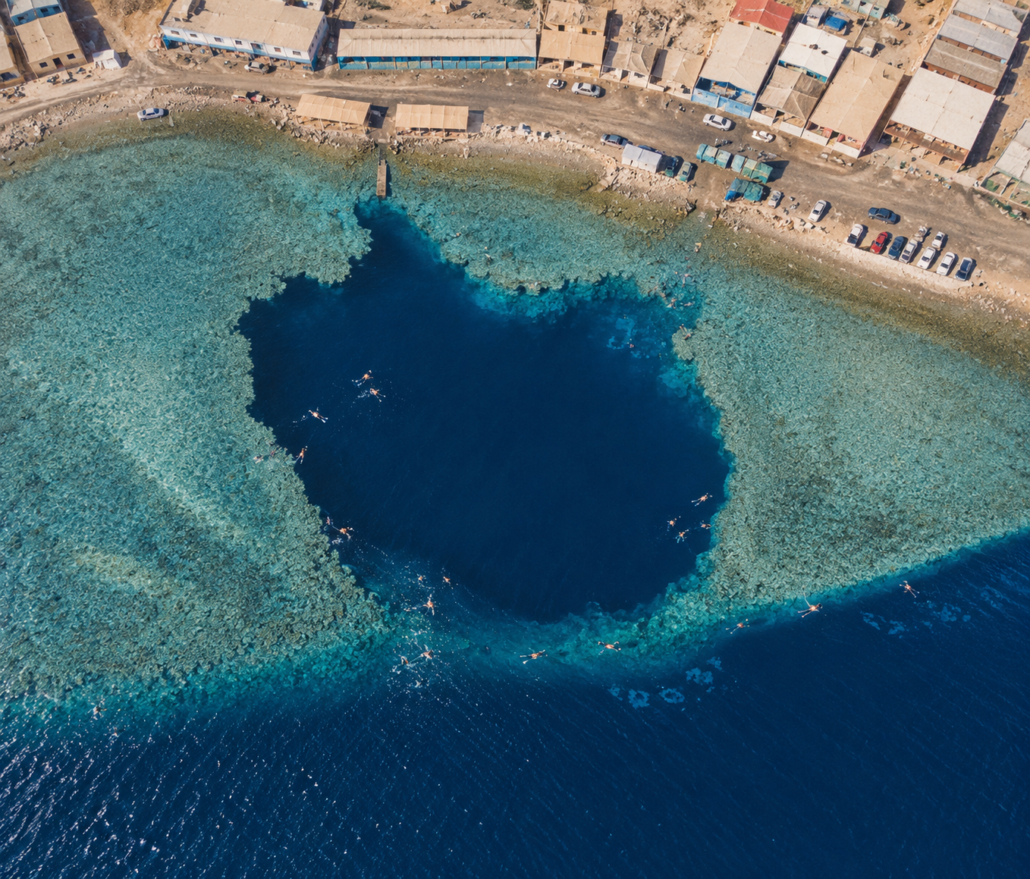
A few kilometres from Dahab, the reef opens into a huge circular formation around 60 metres in diameter, descending vertically to more than 100 metres.
The Blue Hole was formed when the upper part of a cavity in the reef platform collapsed, leaving the opening we see today.
From the surface, it can look like nothing more than a blue hole in the middle of the sea. Once you get in, things change. Inside the Blue Hole, the landscape is very different from other dive sites around Dahab: vertical walls and blue water dominate the experience, and when you look down, the bottom disappears into the blue.
To see the reef at its best, you need to move out towards the outer wall, where the landscape changes completely, with much more coral and marine life.

Why is the Blue Hole in Dahab so famous?
There are two main reasons.
The first is the place itself. It is a spectacular formation and very easy to reach from shore. You don’t need a boat to get there, and you can be in the water just a few minutes after leaving Dahab.
The second is The Arch. The Blue Hole is connected to the open sea by a passage at around 55 metres deep. It is known as The Arch and is probably the most famous — and controversial — part of the whole Blue Hole.
But there is an important distinction to make here. Diving the Blue Hole does not mean going through The Arch. They are two very different things.
The Arch
The Arch is an underwater passage through the wall of the Blue Hole that connects its interior with the open sea. Because of its depth and the nature of the penetration, going through it requires specific technical diving training.
Over the years, there have been serious accidents involving attempts to make this dive without the necessary training, configuration or experience. This is where much of the Blue Hole’s reputation as an extremely dangerous place comes from.
The problem is not simply that the Blue Hole is deep. The problem starts when a dive goes beyond the diver’s training and limits.
If you want to understand the story behind it better, we have written a specific article about The Divers’ Cemetery and The Arch.
What is diving the Blue Hole like?
You enter the water directly from shore. As with almost all the dive sites in Dahab, you arrive by car, get your equipment ready and walk straight into the water.
Once you’re in, you can follow the Blue Hole wall and watch the landscape change as you descend.
The feeling is different from diving on an open reef. The wall drops away around you and the blue takes up more and more of your view.
And yes, there is plenty to look at.
The outer wall of the Blue Hole has beautiful reef and plenty of marine life, especially in the shallower areas. Reef fish, morays, pufferfish, scorpionfish and many of the species you can find at other dive sites around Dahab.
But the fish you just saw probably won’t be what you remember most about this dive.
It will be the hole.
How deep is the Blue Hole?
The Blue Hole is more than 100 metres deep. But that doesn’t mean you have to go anywhere near that depth. For recreational diving, the dive should stay within the limits of your certification and the profile you have planned.
The maximum depth of the site is a characteristic of the place, not a target. It sounds obvious. But at a place like the Blue Hole, it is worth saying. You don’t need to go deeper to enjoy it more.
What level do you need to dive the Blue Hole?
For a recreational dive at the Blue Hole, we recommend having Advanced Open Water and having done some diving in Dahab beforehand.
Not because the Blue Hole is reserved exclusively for experienced divers. Simply because it is better to arrive with some experience.
Dahab has plenty of dive sites where you can get used to shore entries, your equipment configuration, local conditions and the way your guides work before coming here.
Once you have that experience, the Blue Hole stops being something that looks intimidating from the outside and becomes simply another place to dive. A pretty special one, though.
Can you freedive at the Blue Hole?
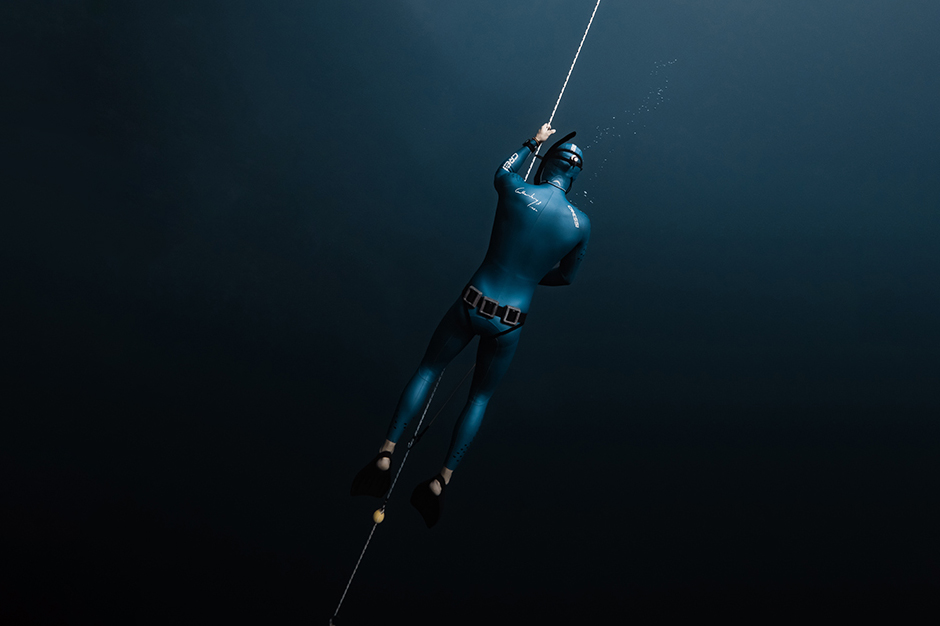
Yes. In fact, the Blue Hole has also become one of the best-known places in the world for depth freediving training. The combination of shore access, depth and usually low current makes it particularly interesting for freedivers.
But the same logic applies: the Blue Hole is not a place to learn how to freedive.
If you want to train depth here, you need the right training and enough experience to know what you are doing.
For experienced freedivers, the Blue Hole offers a very clean water column and conditions that allow you to focus entirely on the descent. If you want to know what it is really like to descend here on a breath-hold, we have a specific article about freediving at the Blue Hole.
Is the Blue Hole dangerous?
This is probably the question we get asked most often. And the answer isn’t simply yes or no.
The Blue Hole is more than 100 metres deep and contains a technical area such as The Arch. That’s a fact.
It is also a fact that there have been serious and fatal accidents here. But putting every type of activity at the Blue Hole into the same category would be a mistake.
A recreational dive, descending through The Bells and visiting the Blue Hole wall, is not the same as attempting to cross The Arch at around 55 metres. Nor is it the same as doing a deep freediving session. Each activity has its own risks, limits and requirements.
As with diving anywhere, your certification isn’t there to ruin your day. It’s there to tell you what you have learned to do safely.
The Blue Hole for scuba divers and freedivers
One of the interesting things about the Blue Hole is that two people can enter the same place and have completely different experiences.
For a recreational diver, it is a dive around an enormous reef wall.
For a technical diver, it can be a place to work on depth and penetration.
For a freediver, it is a deep water column where you can work on your descent.
And for someone simply travelling to Dahab, it is probably one of those places they’ve seen a hundred times on Instagram before arriving.
You don’t have to do all three.
How do you get to the Blue Hole from Dahab?
The Blue Hole is located a few kilometres north of Dahab. You get there by road, and the drive from central Dahab is short — usually around 15–20 minutes, depending on where you leave from and the road conditions.
One of the great things about diving in Dahab is precisely this. You don’t need a boat. Most dive sites are connected by road and accessed directly from the shore. You arrive, get your equipment ready, walk into the water and start diving.
Much easier than mounting an expedition for every dive.
When is the best time to visit the Blue Hole?
You can dive the Blue Hole all year round. As with any dive site, actual conditions can vary depending on the wind, sea conditions and time of year.
If you want to enjoy the Blue Hole with fewer people around, early morning is usually a good option. And there is something about the early morning light on the water.
Blue Hole in Dahab: things worth knowing
Is the Blue Hole far from Dahab?
No. It is a few kilometres north of Dahab and the drive usually takes around 15–20 minutes.
Do I need a boat?
No. The Blue Hole is accessed from shore.
Can I dive the Blue Hole with an Open Water certification?
For a recreational dive at the Blue Hole, we recommend Advanced Open Water and previous diving experience in Dahab.
Do I have to go deeper than 40 metres?
No. The depth of the Blue Hole does not determine how deep your dive has to be.
Is The Arch part of a recreational dive?
No. Going through The Arch is a technical dive and requires specific training.
Can I freedive there?
Yes, as long as you have the training and experience required for the depth session you are planning.
Is the Blue Hole really as dangerous as people say?
The Blue Hole has real risks, especially when deep or technical dives are carried out beyond the limits of the diver’s training.
A properly planned recreational dive is a different activity.